Thursday, November 18, 2010

Nicely done President Bush, Nicely Done

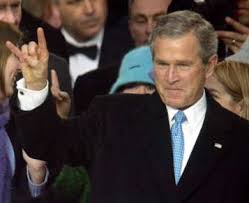
Former President George W. Bush spoke to a crowd of 17,000 spectators at the University of North Texas coliseum last night. While I believe his speech left me wanting, it was a mediocre presentation. As a public relations and marketing student, I wondered what President Bush’s motives for speaking at a known liberal college and how his public relations team finagled it.
President Bush’s presidency was rife with conflict, controversy, and an ever-present degree of skepticism.  Many heralded him as the “dumb” president and of just riding the coattails of his father, President George Bush Sr. While I will not debate his candidacy as a whole nor his political actions, I will analyze his public relations team and their decision to allow President Bush to speak at UNT.
I believe it boils down to two key factors: money and the fact that UNT is a liberal arts school.
Money is a huge factor. President Bush made $100,000 to speak at UNT last night, money that is rumored to have come from students’ tuitions. President Bush made $400,000 per year as president and we gave him a quarter of that to speak for a little over an hour. Needless to say, I was shocked. It’s hard to turn down easy money and President Bush as a business man realized that this was an opportunity to increase his personal income. Still, money would not be the only reason President Bush would speak at UNT.
The biggest question I asked myself when I heard that President Bush was coming to UNT was, “Why?” Why would he choose this school when SMU, Texas A&M or Baylor University would have been more suitable venues with mentalities that were more favorable to President Bush’s ideas. His PR team didn't want to go with the traditional route. They wanted to position President Bush as a man who goes beyond political boundaries, especially for the nation’s students. I believe the team may have even wanted to piggy-back on the 9/11 tale  of how President Bush was reading to the elementary students and after he heard about the plane attack kept reading as to not alarm the children.
I believe speaking to a liberal school as a opposed to a traditionally conservative school was a calculated move by his PR team and I agree with their decision. President Bush is no longer president and must maintain his income. Which equals he must push a product; the physical product being his book and ethereal product being himself. In order to gain a bigger audience and increase the sales of his book, he must branch out to different demographics and show that he can relate to everyone. He needs to portray that what he did in his presidency cannot be summed up by a simple answer and to better understand him as a person, you must read his book.
I believe President George Bush’s PR team was entirely correct in having him speak at UNT and deem it was a brilliant public relations strategy.

Epic is only a Word, Spike Lee is the embodiment

Last Thursday, November 11th, I was privileged to be able to listen to the great filmmaker Spike Lee as he spoke to the University of North Texas students. I have grown up with Spike Lee in a way, all culminating with his amazing HBO documentary, "If God willing and the Creek Don't Rise." Honestly, I was expecting Lee to be dressed in fancy clothes and to speak so eloquently that I would be mesmerized by what he was saying, what I got was a man who reminded me of my grandpa, a soft spoken man with wisdsom beyond time.
I love how he spoke of not knowing what his final career destination was and how he was not the best student academically. But it was so encouraging to to hear him speak about the summer he discovered his passion. I have yet to have that lightning bolt moment, but to hear him speak of his makes the search easier.


His views on the Black culture at the current time are spot on. I agreed with every opinion, especially the about how we criticize our fellow Black students for succeeding academically. His statements about how black students who speak with eloquence and correct diction are called "white" rang extremely true with me seeing how I was called that from age five to the current day. Fortunately, I knew well enough that people were teasing me because of pure jealousy or simply because they did not understand my personality. But what if a Black student is not strong enough to withstand the teasing? Then thats when we have the pseudo mentality that to be a "true Black person" you need to behave as a caricature, a stereotype, a mold that society can understand. My hope is to change this, with every person I meet and with every interaction that takes place, I want to shatter a stereotype and be an example of a strong Black woman.

Friday, November 12, 2010

An Hour of Anticipation


I view this situation from a public relations standpoint. As a public relations professional, we must make sure that our clients are portrayed and perceived as honestly as possible. In James' situation, he was perceived as an attention-seeking athlete. As a PR executive, I would have tested small markets to gauge the reaction of the announcement to the people. To appease the client, I would not have divulged any information that would jeopardize his career or marketability.
 

Secondly, I would have made the fact that all proceeds benefit charity a forefront in the minds of the public. It’s common knowledge that people sympathize with someone doing charitable work.

I believe the minor tweaks and the research I would have done would have sharply decreased or better prepared James for the media fallout and the unpopular public approval.

The setting is July 8, 2010. On a rainy Thursday, the television sets were tuned to ESPN in anticipation of "The Decision". One might assume it was for a presidential speech, but no--It was so Lebron James, basketball player, could announce where the city of his future career.

At 8 p.m. ESPN's ratings skyrocketed, command for ad space was at a high as was the price for that space. James drew extreme criticism for this public meeting. Many saying he was exploiting basketball and diminishing the prestige of the game. Yet, James retort to those claims were that all of the proceeds of the televised hour were being awarded to charity.

James' decision to host "The decision" indelibly weakened his public image. James is marketed as being the All-American phenomenon. He was born and raised in Ohio, decided to forgo college in hopes of NBA stardom, and succeeded beyond anyone's belief. He is often hailed as the next Michael Jordan.

Yet many people, including the most die-hard of sports fans, consider him a traitor, snake and exhibitionist. According to a recent poll, 34% of the population views James negatively.

Wednesday, November 10, 2010

Danica, Danica, Danica

This past weekend, I went to Texas Motor Speedway to watch the NASCAR racing events. Now, I could blog about how in a crowd of 500,000 I only saw about 50 African-American people or how there was an abundance of "Southern" flags with the confederacy symbol on them, but no, I will blog about the over-sexualization of Danica Patrick.

In a sport dominated by men, Danica is the sole female. She an athletic, brown-eyed brunette young woman. She was successful in the IndyCar series and has recently moved up to NASCAR racing.

While I commend her for entering a field dominated by men and being successful in that field, I do not commend her and her marketing team for their over-sexualization of Danica.

To her benefit, or downfall, she a very attractive woman. Often, when attractive women enter fields dominated by men, women feel they must heighten their sexuality as to compete with men and appear more feminine.
I believe Danica should be marketed with the slant of "strong-female-athlete" not a sexually-charged woman who also happens to be an athlete.

Friday, November 5, 2010

Atlanta Thrashers’ Interesting PR Tactic

Last Thursday, October 27th, a story appeared on the Yahoo! Sports blog. I am not usually one to read the sports blog as I am a pop culture kind of girl, but this story captured my attention with its topic: the high number of African-American hockey players on the Atlanta Thrashers team, six in the active roster.
             In a sport not known to be big in the African-American culture, having six players in the entire league is a feat, let alone six on one team.  In fact, having six Black players on the active roster for one team is an NHL record, according to blogger Greg Wyshynski. In his blog, Wyshynski debates whether the high number of Black players on Atlanta’s team is a marketing ploy to reach a new demographic. Atlanta is second in the nation for highest African-American population behind New York. That statistic coupled with the fact that hockey is thought of as a sport with a strong African- American presence lends to the viewpoint that it is an attempt to fill seats to the hockey games.

            If the acquiring of six Black players is merely a marketing attempt by the Atlanta Thrashers, is it a complete exploitation of these players? I understand that need to break into a new demographic and the ending objective is to sell tickets to the games, but if their marketing tactics rest solely on the Black players, I find it exploiting.

            On the other hand, the marketing side of me completely agrees with their marketing tactics. There is obviously an untapped market in Atlanta ripe for targeting. These players are great at their sport and also happen to be African-American. The Thrashers could simply be using the resources given to them to create more revenue. The saying “When life gives you lemons, make lemonade” can definitely be applied here.

            It is obvious I am torn about whether this was a mere coincidence or a gross marketing ploy. I guess the real topic I am debating is exploitation. How far can the Thrashers market these six players before it becomes exploitive? It is still yet to be seen the effects of this advertising upon the African-American demographic in Atlanta. I believe the answer of how exploitive is this campaign really is will be determined by the citizens of Atlanta.

Thursday, November 4, 2010

Dove Campaign for Real Beauty

Recently for a Marketing project, I was called upon to speak about the viral video, "Evolution." We have watched this video in our Race, Gender, Media class and discussed its meaning this that class, but now I had to look at the video from a marketing standpoint.

The video itself is 75 seconds and is the process of which a woman is made "beautiful." She is caked with makeup and photoshopped to the point that she is hardly recognizable. While I praise Dove for this campaign, I wonder what are the marketing implications for this video. Was the Dove brand really that fed up with the idea of beauty that the media portrayed or did they feel that with this video, they could reach an untapped market--liberal woman who are slightly against the media?